
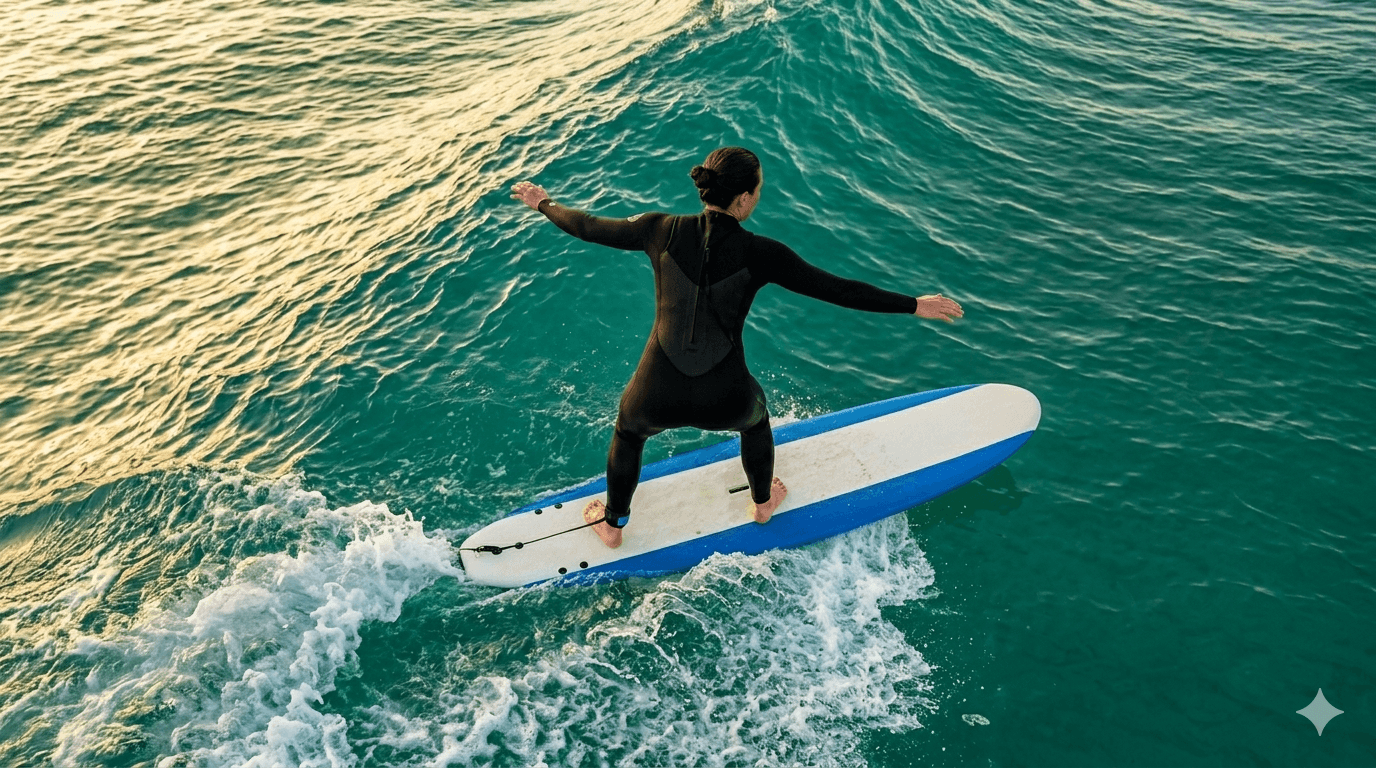
Nobody tells you that the waves come on a timer. You’re floating in this impossibly blue pool, board under your chest, and then — boom — a perfect wave appears out of nowhere from the far end of the lagoon, rolls toward you at a speed that seems both slower and faster than you expected, and you either catch it or you watch it pass while someone behind you doesn’t. That moment, in a nutshell, is your first wave pool session. Here’s how to be ready for it.
The First Thing That Surprises Everyone
The waves come on a timer.
Out in the ocean you’re constantly reading the horizon, watching sets roll in, deciding when to paddle. In a wave pool, that decision gets made for you. A wave appears at the far end of the lagoon — at Urbnsurf Melbourne it emerges from the centre spine, at The Wave Bristol it peels across a 150-metre lake — rolls toward you at a steady, predictable pace, and then it’s gone. Next one in roughly 30–60 seconds, depending on the session setting.
This sounds simple. In practice, it completely rewires your brain for the first 10 minutes. You’ll paddle too early, then too late, then fall off the back because you hesitated. That’s normal. By wave five or six you’ll start to feel the rhythm, and that’s when it clicks — this is actually easier than the ocean.
How a Session Is Structured
Most surf park sessions run for 60 minutes, and the format is roughly the same everywhere. You arrive early (usually 30 minutes before), go through a mandatory safety briefing, get fitted out if you’re renting gear, and then enter the water as a group.
A typical session gives each surfer somewhere between 10 and 15 waves. That number sounds low until you’ve paddled hard for an hour in water that’s generating perfect, relentless waves — then it sounds about right. By minute 40, your arms will have opinions about your life choices. Surf parks are deceptively physical: you’re not waiting around like you do in the ocean. You’re paddling, popping up, paddling back, and doing it again on a tight loop.
One thing beginners consistently underestimate: the waves are fast. Even a “beginner” or “cruiser” setting at parks like Lost Shore Edinburgh or Waco Surf Texas moves quicker than the whitewater you learned on. Your pop-up needs to be committed. Half-measures tend to end face-first.
What to Bring — And What to Leave in the Car
Wetsuit or boardshorts? Depends entirely on the park and the season. Outdoor parks like The Wave Bristol and Lost Shore Edinburgh are cold-water environments — a 3/2 mm wetsuit minimum, 4/3 mm in winter. Indoor parks like Skudin Surf at American Dream in New Jersey are climate-controlled year-round; boardshorts and a rash vest are genuinely fine.
Board: bring yours or rent? Rent it your first time. Seriously. You don’t yet know what thickness or length suits the pool, you don’t know how the wave feels, and most surf parks carry a solid rental quiver. Save your own board for session two when you actually know what you want out of it.
Rash vest: Yes, always. Wetsuit rash is real and it shows up faster than you expect when you’re falling repeatedly on the same patch of arm.
Leash: Most parks require one. Check the specific rules in advance — some specify minimum leash length for certain session levels.
Ear plugs: Optional but underrated. You are going to fall. A lot. Ear plugs are cheap insurance against surfer’s ear before it becomes a problem.
Leave the GoPro mount setup and the three backup boards at home. First session: keep it simple.
Reading the Lineup and Surf Park Etiquette
Wave pool etiquette is a little different from the ocean, and it’s worth understanding before you paddle out — getting it wrong frustrates everyone else in the water.
Priority works by position. Most parks operate a clear rotation — often a designated zone where surfers queue for waves in order. Watch what regulars do for the first few minutes before paddling into a prime spot. Nobody expects a first-timer to know everything, but showing you’re paying attention goes a long way.
Dropping in is still dropping in. The wave is completely predictable and everyone can see it coming, which means there’s no excuse for taking off on someone else’s wave. In the ocean you can claim ignorance. In a wave pool the trajectory is obvious from 50 metres away.
Get out of the wave’s path after your ride. After you kick off or wipe out, move to the sides quickly. The next wave is already on its way whether you’re ready or not. Sitting in the middle of the lagoon mid-session is both dangerous and the fastest way to annoy your entire group.
Talk to people. Surf park lineups are genuinely friendly. Everyone’s a regular or a first-timer, and the shared weirdness of surfing a machine-made wave together tends to make people chatty. If you’re unsure about the rotation, just ask.
Picking the Right Session Level
This is where beginners most often go wrong — picking a level that’s either too advanced (painful and demoralising) or so mellow the waves barely push you (boring). Here’s a plain-English guide:
- Beginner / Cruiser / Waikiki / Intro — Rolling, forgiving waves. Ideal if you’ve had a few lessons but can’t consistently link turns. This is your session. Book it without guilt.
- Intermediate / Turns / Malibu — Steeper, faster, with a shoulder to work. Right for you if you can get to your feet reliably and ride the face rather than just the whitewater.
- Advanced / Barrels / High Performance — Self-explanatory. If you’re asking whether this level is right for you, it probably isn’t yet — and that’s completely fine.
When in doubt, book one level below where you think you are. You’ll catch more waves, build more confidence, and leave wanting to come back — which is exactly how a first session should end.
The One Thing Beginners Always Wish They’d Known
Manage your expectations on day one, and your second session will blow your mind.
First-timers almost universally spend the opening 15 minutes just adjusting — to the timer, to the crowd, to a wave that behaves differently from anything they’ve surfed before. The surfers who enjoy it most are the ones who gave themselves permission to fall, be awkward, and laugh about it. The ones who enjoy it least are the ones who came in expecting to immediately surf the way they do at their home break.
A few rapid-fire things regulars wish they’d known earlier:
- Rent the biggest foamie on the rack. You will get more waves and have more fun. Ego can wait for session three.
- Watch one full wave cycle before paddling for your first one. Just float, breathe, and observe. Thirty seconds of watching will save you five minutes of confusion.
- You will be exhausted. Plan something gentle for the rest of the day. A surf park session on fresh legs is a workout; on unprepared legs it’s a physical event.
The wave pool will reward you. It just needs a few waves to get there.
When you’re ready to come back — and you will be — Surf Session Finder tracks session availability at Urbnsurf, The Wave Bristol, Lost Shore, Waco Surf, and more, so you’ll know the moment a slot opens up without living on the booking page.