
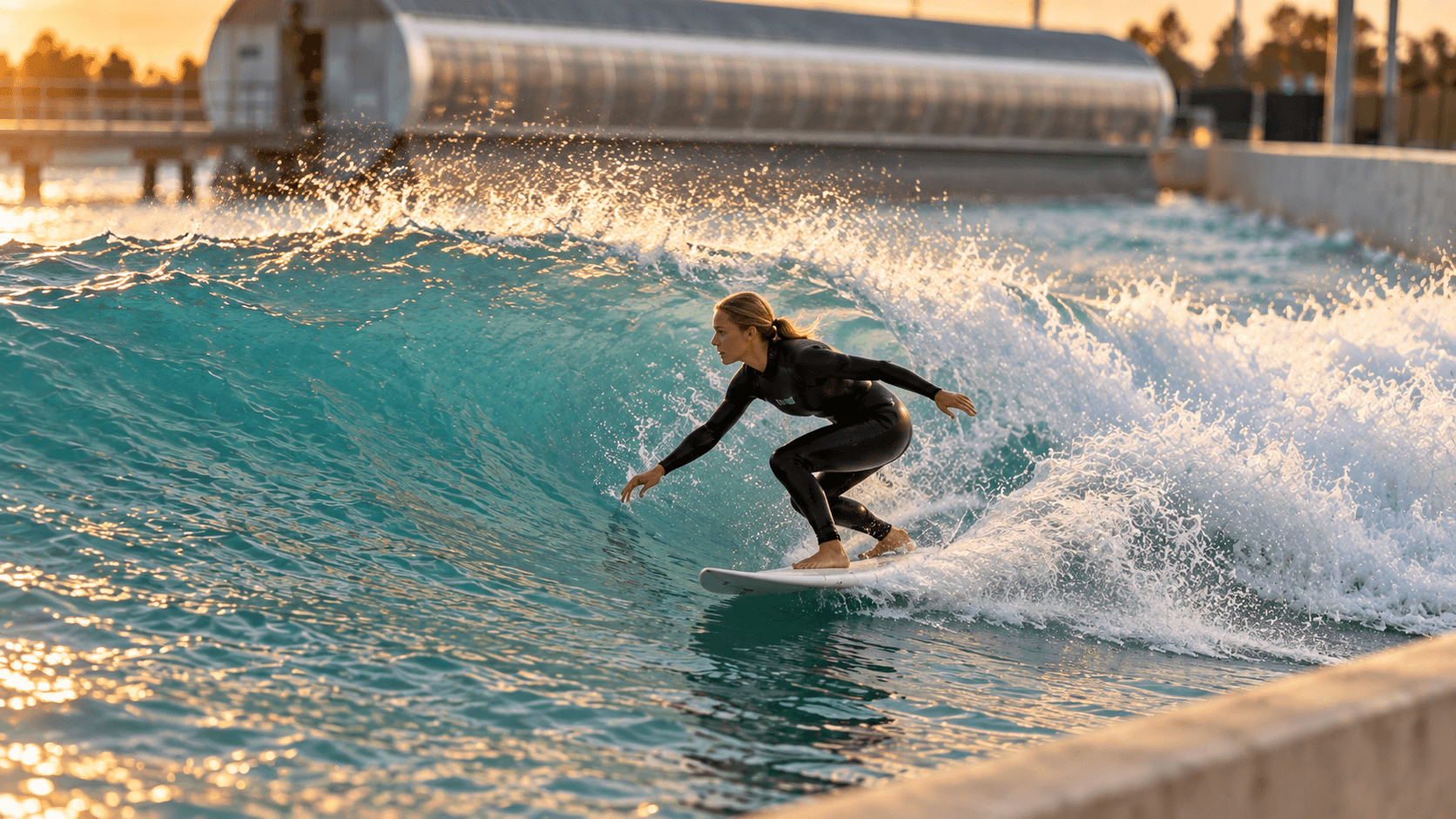
You’ve had the Intermediate wave dialled for weeks. Every takeoff makes, you can sneak a turn in, and lately the session feels like a good workout rather than a challenge. So you open the booking page, hover over “Advanced”, look at the price, remember the video of someone getting pitched on that exact wave - and book Intermediate again. Sound familiar? Here’s how to tell whether you’re really ready to move up, and how to make your first session at the next level count.
The Plateau Nobody Talks About
Wave pools are brilliant for progression right up until they aren’t. The same wave, the same section, the same turn in the same spot - repeatable is great when you’re learning, and quietly limiting once you’ve learned it. You stop getting better and start getting comfortable.
The problem is that the next level looks like a big jump from the channel. It usually isn’t as big as it looks, but it isn’t nothing either. Knowing what actually changes is the first step to deciding.
What Actually Changes When You Move Up a Level
At most parks, going up a level changes a handful of things at once:
- Size and speed. The wave is bigger and runs faster down the line, so you have less time to set your rail after the pop-up.
- A steeper takeoff. Late or hesitant paddling that got away with it on a softer wave now means nosediving or getting left behind.
- Less recovery time. Waves often come through more frequently, so the paddle back feels shorter and a wipeout costs you more.
- A stronger lineup. The surfers around you are better, which is inspiring and intimidating in roughly equal measure.
It’s also worth knowing that level names don’t translate cleanly between parks. Urbnsurf Melbourne’s wave types run from Cruiser through Intermediate, Advanced and Expert, with dedicated Barrel and Advanced Turns sessions on top, and they’re typically in the AUD $85-$120 range. The Wave Bristol’s wave types use similar names, but “Advanced” in Bristol won’t feel identical to “Advanced” in Melbourne, and SRF Park Tel Aviv uses numbered levels from L1 to L6. Read the park’s own description before assuming your level carries over.
The Readiness Checklist
Be honest with yourself. If you can tick most of these on your current wave, you’re probably ready:
- You make 8 out of 10 takeoffs without rushing or pearling.
- You go down the line straight away instead of riding straight to the flats first.
- You can link two manoeuvres - a bottom turn into a top turn, or a cutback back into the pocket.
- You pick your spot before the wave arrives instead of scrambling once it’s on you.
- You finish the session with gas left and your paddle back isn’t the hardest part of the hour.
Missing one or two isn’t a dealbreaker. Missing four means another few sessions at your current level will do more for you than a humbling hour one level up.
Why Your First Session Up Should Be a Quiet One
Here’s the part most surfers skip. Your first session at a harder level is going to include some missed takeoffs and a couple of ugly wipeouts. That’s fine - the question is how many chances you get to try again.
In a full session of 16 surfers, each miss can cost you several minutes before your next go, so you might only get six or seven real attempts. Drop that to 5 or 6 surfers and the numbers flip - we broke this down properly in Wave Math: Why Low-Count Sessions Beat Full Ones. More attempts means you actually adapt to the wave instead of spending the hour recovering from the first mistake.
There’s a headspace benefit too. Blowing a takeoff in front of a lineup of stronger surfers is exactly the feeling we wrote about in The Paddle of Shame. A quieter session takes most of that pressure away, which matters when you’re already a bit nervous.
Signs You Should Wait Another Few Sessions
Moving up isn’t a test you have to pass on a schedule. It’s worth staying put for a bit if:
- You’re still getting caught inside or losing boards on your current wave
- Your pop-up still involves a knee
- You’re only considering it because a friend booked Advanced
- The thought of the session is more stress than excitement
None of that is failure. Another few focused sessions where you work on one specific thing - earlier bottom turns, say - will make the step up feel natural rather than scary.
Finding That First Low-Count Session
Once you’ve decided to go for it, the tricky part is getting a quiet slot at the new level. Harder sessions often sell out fast, and the low-count ones tend to appear through cancellations or awkward weekday times that nobody checks.
That’s where Surf Session Finder does the heavy lifting. Set an alert for the level you want at your park, choose the days you can surf, and you’ll get a ping as soon as a session opens up or the count drops. If you’d rather just ask, the AI schedule assistant can pull up matching Advanced sessions from the live schedule - tell it your level, the day and how quiet you want it.
Ready to move up without paying for an hour of watching other people surf? Set up your free alerts at surfsessionfinder.com and let Surf Session Finder find your first session at the next level.
Published by Surf Session Finder - Free alerts to help surfers find low-count surf park sessions.